

10 Fun Gross Motor Activities for Preschoolers
Gross motor skills are an important part of early childhood development. Running, jumping, balancing, climbing and crawling give young children opportunities to explore how their bodies move and become more confident in their physical abilities.
Gross motor activities for preschoolers do not have to be complicated. A few versatile movement materials can already create many different games and challenges.
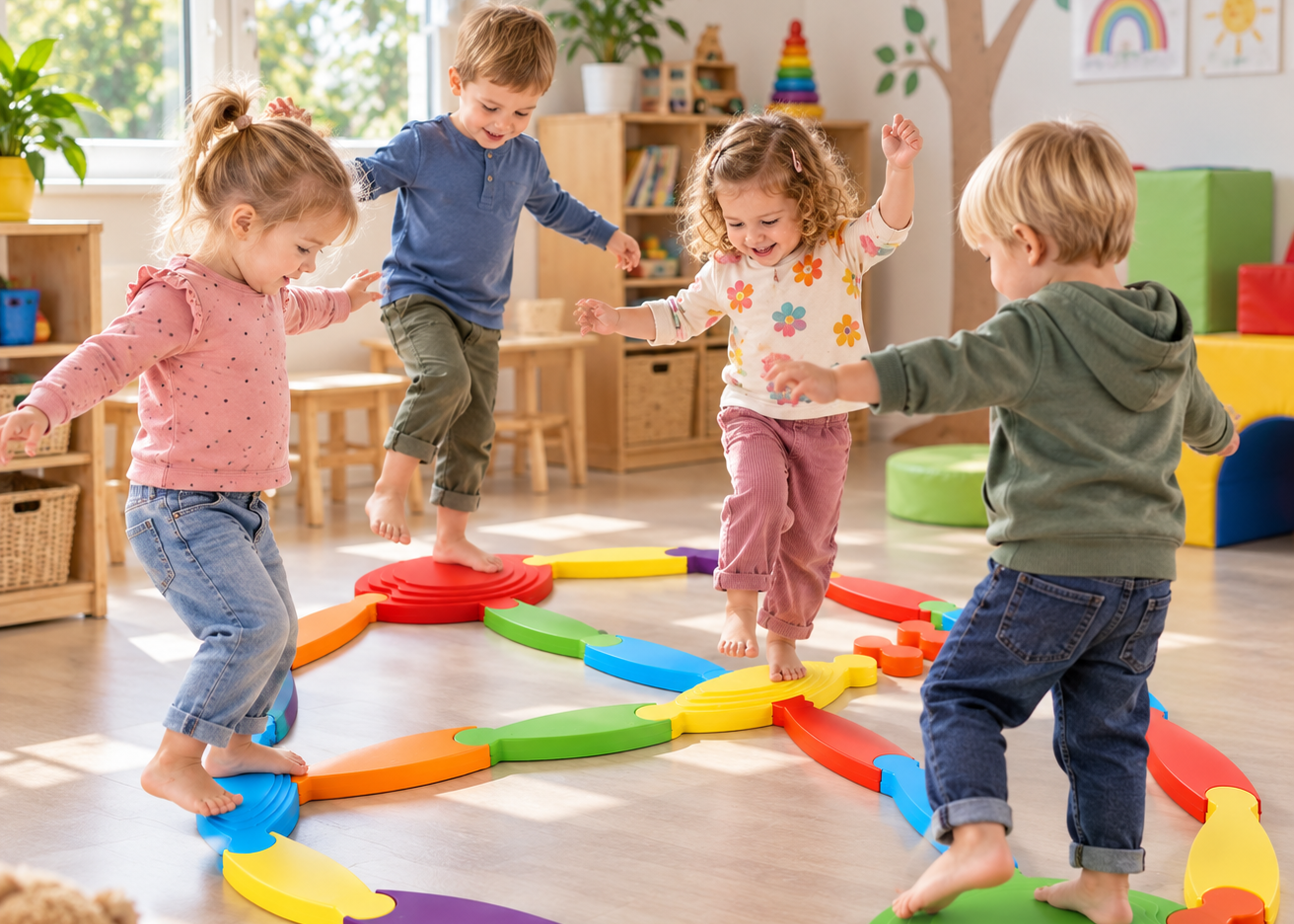
With materials such as Gonge River Stones, Gonge Build N' Balance and the Gonge Air Board, you can easily create a movement course in a preschool, daycare centre or classroom.
Why are gross motor activities important for preschoolers?
Young children learn through movement. When they walk across a balance element, jump from one point to another or crawl under an obstacle, they are constantly adjusting their body position and movements.
Gross motor play can help children practise:
- balance and body control;
- coordination;
- spatial awareness;
- jumping and landing;
- climbing and crawling;
- following movement instructions;
- confidence in physical activities.
The activities do not need to be competitive. The aim is to give children plenty of opportunities to move, explore and practise at their own level.
Discover our gross motor skill toys
Here are 10 fun ideas to get children moving.
1. The Floor Is Lava with Gonge River Stones
Material: Gonge River Stones
Turn an ordinary classroom or playroom into an imaginary adventure.
Place the Gonge River Stones at different distances across the floor. The children have to get from one side of the room to the other without touching the “lava”.
For younger children, place the stones close together. Older preschoolers can try larger gaps or jump from one stone to the next.
You can also change the rules:
- Jump like a frog from stone to stone.
- Stand still for three seconds on each stone.
- Carry a small object to the other side.
- Only step on stones of a certain colour.
The same equipment can therefore create many different gross motor games for preschoolers.
2. Cross the River – Build a Movement Adventure
Material: Gonge River Landscape
Create an imaginary river that the children have to cross.
Use the different elements of the Gonge River Landscape to create a route with islands, stepping areas and different levels.
The children can walk, step, balance and move from one element to another to reach the other side.
The great thing about this activity is that the layout can be changed regularly. A small change in the arrangement creates a completely new challenge.
For a group of preschoolers, you can also let the children help decide where the different elements should go.
3. Build a Balance Course with Gonge Build N' Balance
Material: Gonge Build N' Balance
The Gonge Build N' Balance system is ideal for creating a balance course that can be adapted to different ages and abilities.
Start with a simple path and gradually add more elements. Children can walk across the planks, change direction or step from one part of the course to another.
For an extra challenge, ask the children to:
- carry a beanbag;
- stop halfway and hold their balance;
- walk backwards with help;
- choose their own route;
- build a new course for another child.
This activity combines balance, coordination and problem-solving with active play.
4. Move Like an Animal
You don't always need equipment for gross motor activities.
Ask children to move through the room like different animals:
- Hop like a frog.
- Walk like a bear.
- Crawl like a snake.
- Jump like a rabbit.
- Stretch up high like a giraffe.
- Walk quietly like a cat.
You can combine the animal movements with a simple movement course. For example, children might walk across the River Stones like a cat and then crawl under an obstacle like a snake.
This is a simple way to turn movement into imaginative play.
5. The Colour Movement Course
Create a simple indoor course using different coloured movement materials or markers.
Give the children instructions such as:
“Jump to red, walk to blue and crawl to yellow.”
You can gradually make the game more challenging by combining several instructions.
For example:
Red – jump twice → blue – balance → yellow – crawl → green – turn around.
This type of indoor gross motor activity combines physical movement with listening, attention and memory.
6. Gross Motor Skills for 2 Year Olds: Explore and Move
Two-year-olds are still discovering what their bodies can do. At this age, movement activities should be simple and give children plenty of opportunity to explore.
When planning gross motor skills for 2 year olds, you can use:
- low balance elements;
- large stepping areas;
- simple obstacles;
- tunnels;
- floor markers;
- soft materials to climb over or around.
Don't worry about creating a fixed course. A few elements placed around the room can already encourage children to walk, step, climb, crawl and change direction.
The adult can demonstrate a few possibilities while allowing children to explore the equipment in their own way.
7. Stop, Go! A Movement Game with Music
Music can make a simple movement activity much more engaging.
When the music plays, the children move around the room. When the music stops, everyone freezes.
You can introduce new instructions:
- Walk slowly.
- Move quickly.
- Jump when the music starts.
- Freeze on one foot.
- Walk backwards.
- Move like an animal.
The game can be made easier or more challenging depending on the age of the children.
8. Improve Balance with the Gonge Air Board
Material: Gonge Air Board
The Gonge Air Board gives children a fun way to practise balance and body control.
The challenge is to find a stable position and control their movements while standing on the board.
For younger children, simply stepping onto the Air Board with adult support can already be an interesting experience.
Older preschoolers can try to maintain their balance for a few seconds, move their weight from side to side or include the Air Board as one part of a larger movement course.
9. Gross Motor Skills for 3 Year Olds: Add More Challenges
By the age of three, many children are ready to combine several movements in one activity.
When planning gross motor skills for 3 year olds, you can create a simple sequence such as:
balance → jump → crawl → climb → turn around → balance again.
You can also give children a small object to carry through the course or ask them to remember the order of two or three movements.
The important thing is to adapt the challenge to the individual child. One child may be ready for a more difficult balance element, while another may still be practising the basics.
10. Let Children Build Their Own Movement Course
Why not let the children design the course themselves?
Place different movement elements around the room and ask the children which ones they would like to use.
With Gonge Build N' Balance, for example, children can help decide how the different elements should be connected.
They can then test their course and make changes when something is too easy or too difficult.
This activity combines large motor activities for preschoolers with creativity, cooperation and problem-solving.
What equipment can you use for gross motor activities?
You don't need a huge collection of equipment to create varied movement activities. A few versatile pieces can be used in many different ways. You can also explore our selection of Gonge movement equipment, designed to encourage balance, coordination and active play.
Gonge River Stones
River Stones are useful for balancing, stepping and jumping activities. The different sizes and heights make it easy to adapt the challenge.
Gonge River Landscape
The River Landscape can be arranged in different ways to create movement routes, stepping challenges and imaginary rivers.
Gonge Build N' Balance
Build N' Balance is particularly useful for creating balance courses that can grow with the children.
Gonge Air Board
The Air Board provides an additional balance challenge and can be used on its own or as part of a larger course.
Gonge Carousel
The Gonge Carousel introduces movement and balance in a different way and can be used as an additional element in a preschool movement area.
The advantage of these materials is their versatility. Instead of using one product for one specific game, children can discover different ways of moving with the same equipment. Movement activities can also be combined with sensory equipment, giving children additional opportunities to explore textures, movement and their surroundings.
How to organise a movement course for preschoolers
A movement course does not need to fill an entire room.
When setting up an activity, make sure that:
- children have enough space to move safely;
- the route is easy to understand;
- the first activity is relatively simple;
- there are different levels of challenge;
- children can repeat activities;
- the layout can easily be changed.
A simple course can be just as valuable as a complicated one. What matters is that children have opportunities to move, explore and practise different gross motor skills.
Gross motor activities for different ages
The same equipment can often be used with children of different ages. The difference is mainly in the way the activity is presented.
2-year-olds
Keep activities simple and focus on exploration. Walking, stepping, crawling and climbing over low obstacles are suitable starting points.
3-year-olds
Three-year-olds can usually handle slightly longer movement sequences. You can introduce simple instructions and combine several different movements.
Older preschoolers
Older children can take on more complex balance challenges, remember a sequence of movements or help build their own course.
This makes it possible to use the same movement materials with a mixed-age group.
Gross motor play doesn't have to be a competition
Movement activities are sometimes turned into races: Who is fastest? Who finishes first?
But that doesn't have to be the goal.
For one child, the challenge may be crossing a balance beam without stepping off. For another, it may be trying a new jump or climbing over an obstacle independently.
Giving children the freedom to practise at their own pace creates a more inclusive movement experience.
FAQ – Gross Motor Activities for Preschoolers
What are good gross motor activities for preschoolers?
Good activities include balancing, jumping, climbing, crawling, stepping and moving through simple obstacle courses. Imaginative games such as “The Floor Is Lava” can make these activities even more engaging.
What are good gross motor skills for 2 year olds?
Two-year-olds can practise walking, climbing, crawling, stepping over low obstacles and maintaining their balance. Activities should be simple and allow plenty of free exploration.
What are good gross motor skills for 3 year olds?
Three-year-olds can practise combining movements such as jumping, balancing, crawling and climbing. Simple movement sequences and obstacle courses can provide additional challenges.
What are some indoor gross motor activities?
Indoor activities can include balance courses, stepping games, animal movements, music-and-movement games and simple obstacle courses. Equipment such as Gonge River Stones and Build N' Balance can be adapted to the available space.
What are some outdoor gross motor activities for preschoolers?
Outdoors, children have more space to run, jump and climb. You can create obstacle courses, stepping routes and balance challenges or combine movement games with natural elements such as grass, playground equipment and logs.
Make movement part of the preschool day
Gross motor development doesn't have to happen only during a dedicated PE or movement session.
A few minutes of movement can easily be incorporated into the daily routine. A short balance course before an activity, an animal movement game between two activities or a quick jumping game can all encourage children to be active.
By regularly changing the activities and challenges, children get many opportunities to practise their gross motor skills in a playful way.
Discover more gross motor and balance equipment
Looking for equipment to encourage movement, balance and motor development in preschool, daycare or early childhood settings?
Discover our balance toys
You can find balance equipment from brands such as Gonge, designed to help children practise balance, coordination and body control through active play.

